Buying
Car Inspection Checklist: What to Ask for on Photos and Video
A car inspection checklist for buying a car in Dubai from abroad: the 12 photos to request, what to watch and hear on a live video, the papers and VIN to see on camera, red flags and what a video cannot show.
Most buyers in Africa never see their Dubai car until it reaches the port, so the photos and the video are the inspection. This car inspection checklist tells you exactly what to ask the seller to photograph and film, what to watch and listen for on a live video, which papers to see on camera and the red flags that should stop the deal. It builds on our guide to buying a car from Dubai without visiting.
In short: ask for a fixed set of photos first, then a live video with a cold start, a walkaround, the underside and a short drive, with the VIN shown on the car and on the papers. If the seller will not show something, treat that as the answer.
Why photos and video are your car inspection checklist#
An advert shows a car at its best: clean, polished and photographed from flattering angles. A good remote check turns the seller's claims into evidence you can see. Photos let you study the body, the panels and the interior at your own pace, and send them to a mechanic at home. A live video shows what photos cannot: how the engine starts, what warning lights stay on, how the car sounds and drives, and that the car on camera is the one on the papers.
We share the VIN and a live video of any car before payment. Use the lists below to decide what you ask to see on that video, and do the same with any seller.
Ready to ship your vehicle?
Tell us your destination port and we'll come back with an all-in export quote.
The photo list to request first#
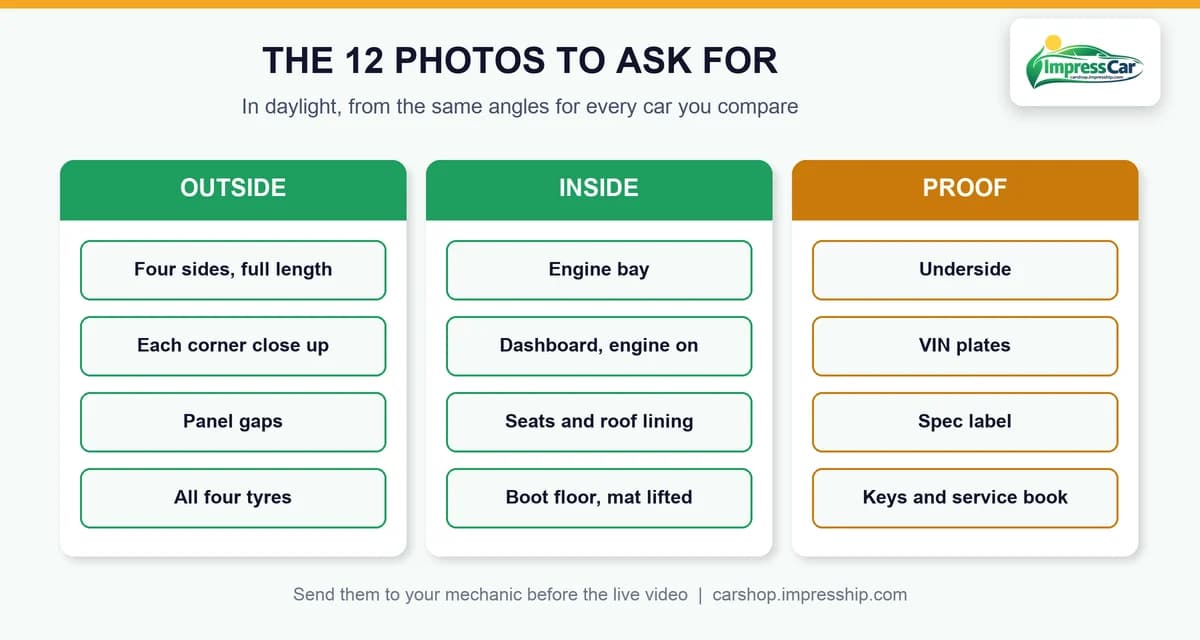
Ask for photos in daylight, from the same angles for every car you compare, so you can judge them side by side.
| Photo | What it shows you |
|---|---|
| Front, rear and both sides, full length | Panel alignment, paint colour match, ride height |
| Each corner close up | Bumper repairs, scuffs, lamp condition |
| Panel gaps on bonnet, doors and boot | Even gaps; uneven ones suggest a past repair |
| All four tyres, tread and sidewall | Wear pattern, matching brands, tyre age |
| Engine bay with the bonnet open | Leaks, missing covers, fresh paint or new bolts |
| Dashboard with the engine running | Mileage and any warning lights still on |
| Front and rear seats, roof lining | Wear that should match the mileage |
| Boot floor with the mat lifted | Rust, water marks, the spare wheel |
| Underside, front and rear | Rust, leaks, damage to the subframe |
| VIN plate on the windscreen and door pillar | The VIN you will check against the papers |
| Spec label or sticker | GCC or other spec, and the steering side |
| Keys and service book | Number of keys, service history if any |
The live video checklist#
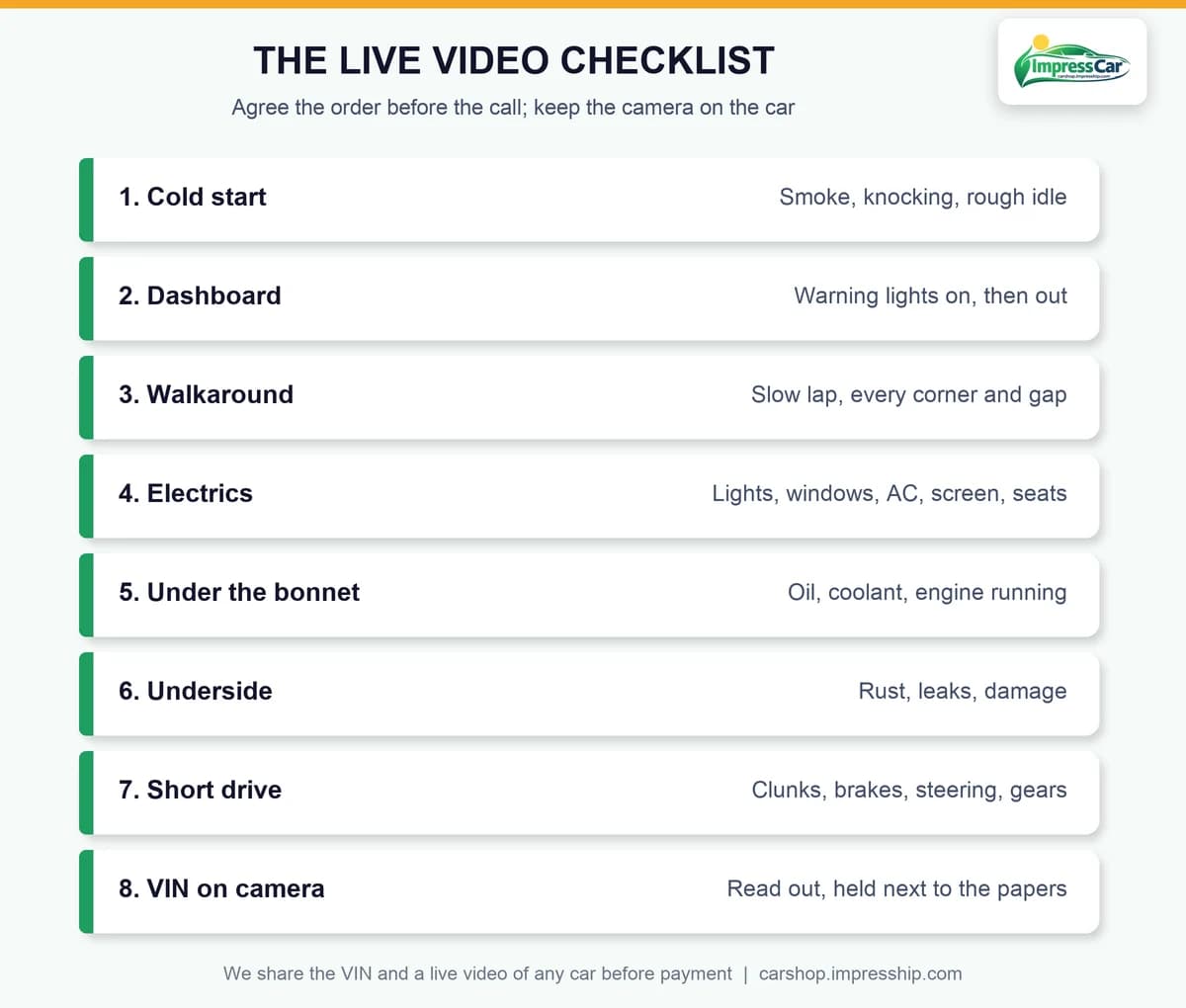
A live video call is better than a recorded clip, because you can ask for things as you go. Agree the order before the call and ask the seller to keep the camera on the car.
- Cold start. Ask for the engine to be cold when the call starts. Watch the exhaust for smoke and listen for rattles, knocking or a rough idle in the first minute.
- Dashboard. All warning lights should come on at ignition and go out after the start. A light that stays on, such as the engine, airbag or ABS light, needs an explanation.
- Walkaround. A slow lap of the car in daylight, stopping at each corner and each panel gap.
- Electrics. Lights, indicators, wipers, windows, mirrors, locks, air conditioning on cold, screen, camera and seats, one by one. Ask which features do not work.
- Under the bonnet. Oil level and colour on the dipstick, coolant, and the engine running with the bonnet open.
- Underside. The camera held under the front, middle and rear, looking for rust, fresh leaks and damage.
- Short drive. If the car can be driven, ask for a short drive with the phone on the dashboard: listen for clunks over bumps, brake noise and steering vibration, and watch the gear changes.
- VIN on camera. End with the VIN on the windscreen and the door pillar, read out loud, then held next to the papers.
Ask for a recording of the call, or record it yourself with the seller's agreement, so you can review it with your mechanic.
Papers and VIN: what to see on camera#
The car on the video must be the car you are paying for. On the call, or in clear photos afterwards, check:
- The VIN on the car matches the invoice and the vehicle papers exactly. Our VIN check guide explains what each part of it tells you and which records to pull yourself.
- Recalls. For a car built for the US market, look up the VIN on the NHTSA recall search to see any open safety recall.
- The spec and steering. GCC, American, Canadian and other specs differ, and Japanese and some European cars are right hand drive. Our GCC spec vs US spec guide explains why it matters.
- The mileage on the dashboard matches the advert and wear on the seats, pedals and steering wheel.
- The export route. The car must be free of loans and fines and get an RTA export certificate before it can leave the UAE.
Red flags on photos and video#
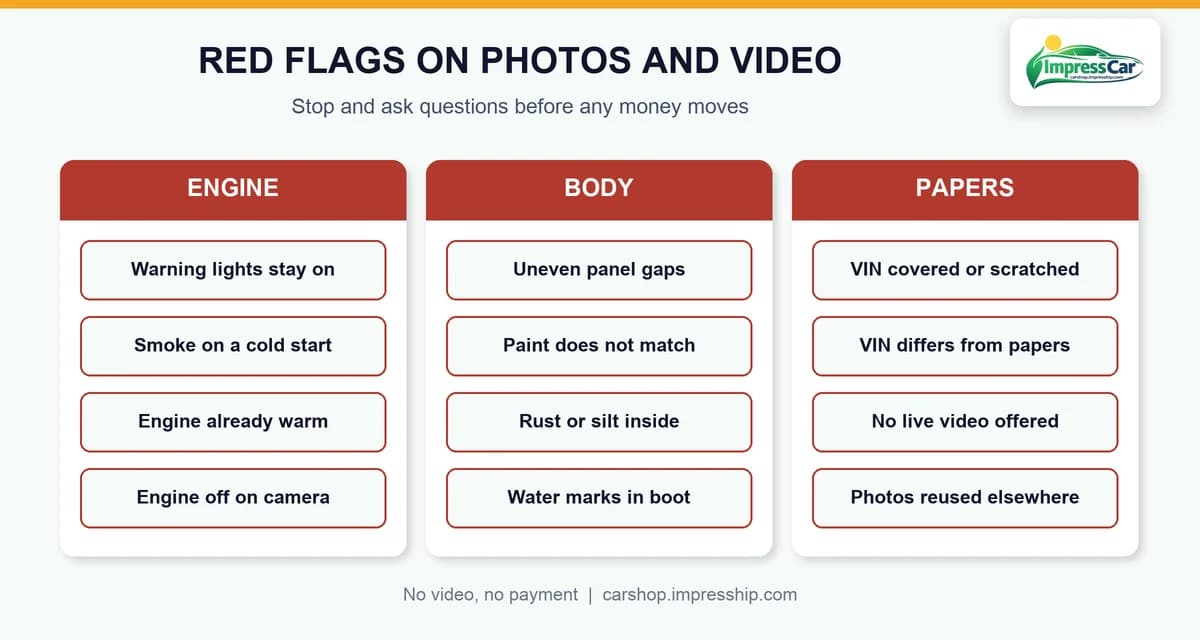
Stop and ask questions when you see any of these:
- Warning lights that stay on, or a dashboard filmed only with the engine off.
- Smoke, knocking or a rough idle on a cold start, or a car that is already warm when the call begins.
- Uneven panel gaps, paint that does not match or overspray on rubber seals: signs of a past repair.
- Rust, silt or water marks under the carpets, in the boot or on the seat rails: signs of a flood car. Our guide to salvage cars for export explains which damage to walk away from.
- A VIN that is scratched, covered or different on the car and the papers.
- Photos that do not match the video, or the same photos used for several adverts.
Our guide to Dubai car export scams covers the tricks that start with good photos, such as a different car on the video or changed bank details.
What photos and video cannot tell you#
A remote check is strong on the outside, the cabin and how the car starts and sounds. It is weak on things only tools or a lift can show: the condition of the gearbox inside, hidden structural repairs under fresh paint, the real state of the suspension and a fault that appears only when the car is hot after a long drive. A video also cannot prove a car's history. For that, run your own VIN and title checks, as our VIN check guide explains.
For an expensive or older car, many buyers pay for an independent inspection in Dubai by a garage or inspector they choose. If you want your own inspector to see the car, tell us before you pay. Whoever sells you the car, our comparison of dealer vs auction vs private seller shows which checks each source lets you make; auction cars are sold as seen, with a condition report instead of a video, as our guide to buying cars at UAE auctions explains.
After the video: reserve, pay and ship#
Once the car passes your checklist, ask for a written invoice that names the car by its VIN and price, pay by traceable bank transfer to the company named on the invoice, and keep the video. Before loading, dated photos of the car help separate old marks from anything that happens on the way; our guide to preparing a car for shipping lists what to do. Marine insurance is optional, at our insurance rates from 1.0 percent for Total Loss Only and 1.75 percent for All Risk Marine. When the car arrives, check it against your photos and video at the port before you sign for it.
Frequently asked questions#
What should I look for in a car inspection?#
Look at the body for uneven panel gaps, mismatched paint and rust; the tyres for uneven wear; the engine for leaks and smoke on a cold start; the dashboard for warning lights; the cabin for wear that does not match the mileage; and the underside for damage. Then check the VIN on the car matches the papers. On a remote purchase, ask to see each of these on photos and a live video.
How do I inspect a used car before buying it?#
If you cannot see it in person, ask for a fixed set of daylight photos, then a live video with a cold start, a slow walkaround, every electric feature, the underside and a short drive, ending with the VIN on camera next to the papers. Send the photos and the recording to your mechanic, and run your own VIN checks with our VIN check guide before you pay.
Do you need a professional inspection for a used car?#
It is not required, but it is worth it for an expensive, older or imported car, because a mechanic with tools can find gearbox, chassis and electrical faults that photos and a video miss. A video and photos are a strong first filter; a professional inspection is the second step for the cars that pass. If you want your own inspector to see a car before you pay, tell us first.
Browse thousands of cars or send the car you want#
Choose a car from our inventory and ask for its VIN and a live video before you pay, using the checklist above. Or send us the car you want with your budget and port, or use the WhatsApp button below.
- Buying
- Guide
- Africa
Ready to ship your vehicle?
Tell us your destination port and we'll come back with an all-in export quote.
Related reading
Buying
Salvage Cars for Export: Accident Cars from Dubai to Africa
Salvage cars for export from Dubai: what counts as an accident or salvage car, which damage to accept and which to walk away from, what Ghana and Nigeria allow, the checks before you pay and how damaged cars ship.
Buying
Pickup Trucks for Africa: Hilux vs Navara vs L200 from Dubai
Pickup trucks for Africa compared: the Toyota Hilux, Nissan Navara and Mitsubishi L200 in Dubai stock, their engines and generations, how Ghana and Nigeria treat a pickup, the right hand drive trap and the checks before you pay.
Buying
Kia Sportage Export Guide: Sportage, Sorento and Santa Fe
Kia Sportage export from Dubai to West and Central Africa, with the Kia Sorento and Hyundai Santa Fe: which generations and engines are in stock, how Ghana and Nigeria tax each engine, GCC vs American spec, and the checks before you pay.