Nigeria
Are Electric Cars Duty Free in Nigeria? How to Get the IDEC (2026)
Are electric cars duty free in Nigeria? Which EVs qualify under the July 2026 Customs rules, how to get the IDEC on idec.gov.ng step by step, the documents and fees, the approval time risk, and what our EV stock data shows.
Are electric cars duty free in Nigeria? Yes, with conditions. Under rules Nigeria Customs announced on 30 July 2026, fully electric cars and extended range EVs with at least 200 km of electric range enter free of import duty and VAT, but only with an Import Duty Exemption Certificate (IDEC). Hybrids and cars worth USD 100,000 or more still pay.
This IDEC electric car Nigeria guide covers the part most answers skip: how to get the certificate. It lists which cars qualify, the documents and fees on the official IDEC portal, the timing risk that agents warn about, how many of the electric cars in our Dubai stock fit the rules, and the checks to make before you pay. Facts were checked on 21 November 2026.
Which electric cars qualify for duty free entry#
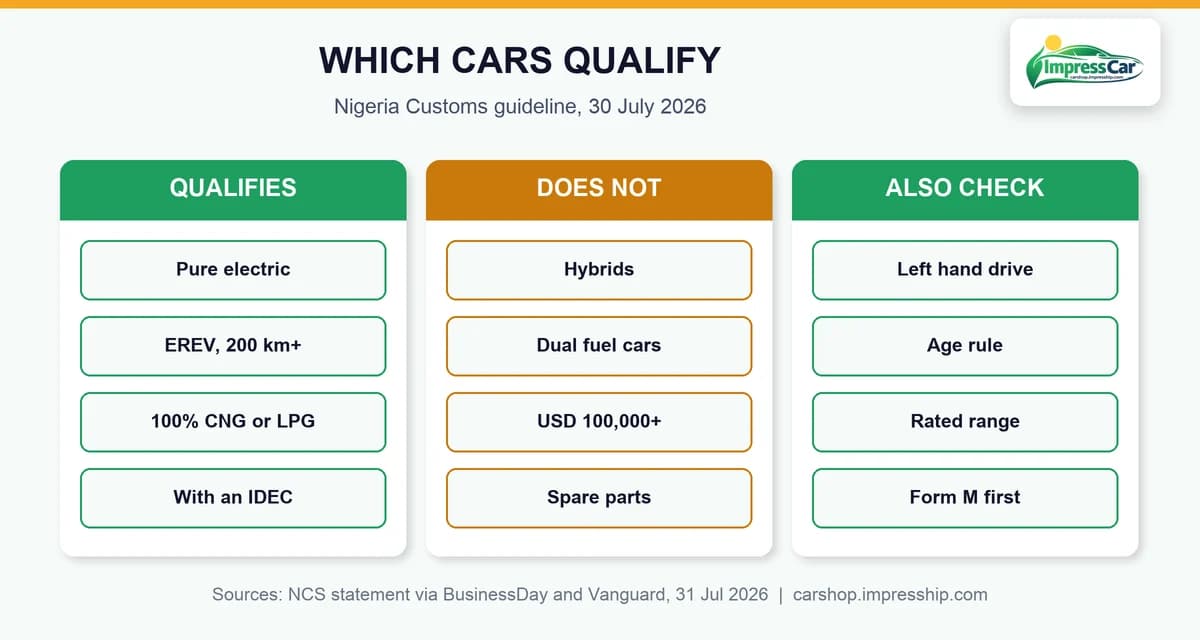
The waiver comes from guidelines issued by the Federal Ministry of Finance under the Presidential Gas for Growth Initiative. Nigeria Customs published them in a statement on 30 July 2026, reported by BusinessDay and Vanguard the next day.
| Eligible for the waiver | Not eligible, pays duty and VAT |
|---|---|
| Pure (battery) electric vehicles | Hybrid electric vehicles |
| Extended range electric vehicles (EREVs) with at least 200 km of electric range | Dual fuel CNG and petrol or diesel vehicles |
| 100 percent CNG and 100 percent LPG vehicles | Luxury vehicles valued at USD 100,000 or more |
| CNG and LPG conversion kits | CNG conversions done overseas without factory fitted systems |
| Certified gas powered tricycles and motorcycles | Spare parts of all kinds |
Three practical points follow from the list:
- Plug in hybrids are not on the eligible list. BYD models badged "DM-i" or "DM-p" are plug in hybrids. Treat them as paying the normal duty unless Customs confirms otherwise in writing.
- The 200 km rule is about the rated electric range. A range extender car with 150 km of electric range does not qualify. Ask for the official range figure for that exact version before you buy.
- The waiver covers import duty and VAT. Electric cars are also outside the Green Tax on cars in Nigeria, which applies by engine size. Ask your clearing agent which port charges and levies still apply to your car.
The other rules for every car still apply: Nigeria bans right hand drive cars under regulation 128 of the National Road Traffic Regulations, 2012, and the age limit is reported as 12 years on the Customs prohibition list but 15 years on the Nigeria Trade Information Portal, so confirm the current rule before you buy.
Ready to ship your vehicle?
Tell us your destination port and we'll come back with an all-in export quote.
IDEC electric car Nigeria: how to apply, step by step#
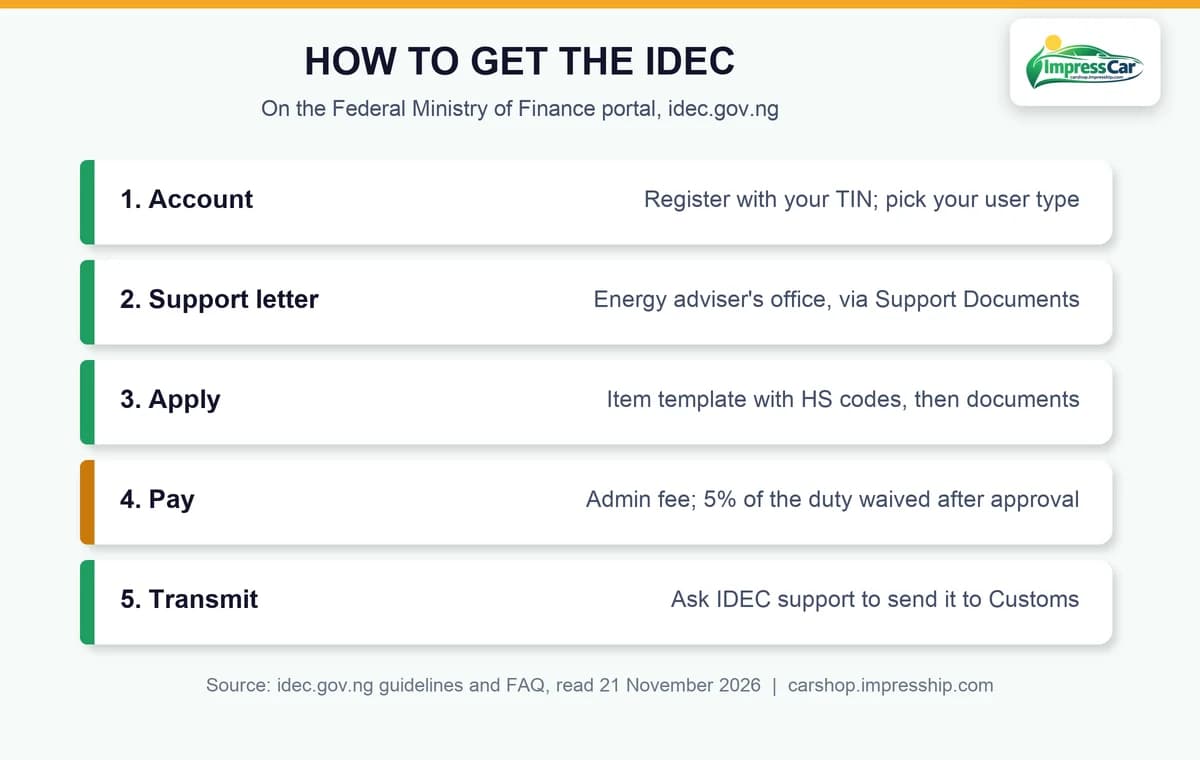
All IDEC applications go through the Federal Ministry of Finance portal at idec.gov.ng; manual applications have not been accepted since 1 March 2020. The steps below come from the portal's own guidelines and FAQ and the Office of the Special Adviser to the President on Energy, which handles the support letter for clean energy vehicles.
- Create an account. On idec.gov.ng, click Get Started, choose your user type (Government, Corporate, NGO or Individual), enter your Tax Identification Number (TIN) and confirm your email.
- Get the support letter. In the Support Documents tab, click Apply, choose "Office of The Special Adviser to the President on Energy" as the MDA, upload the documents it asks for and submit. The Energy Reforms page lists these clicks.
- Start the IDEC application. Click Apply, enter the project name, a brief, the location and the benefiting sector, then download the Excel template and list each item with its HS code.
- Upload the documents. The portal FAQ lists an application letter, a pro forma invoice, the bill of lading, a tax clearance certificate, the CAC document, Form M and the support letter.
- Pay the administrative fee. The guidelines set a non refundable fee of N60,000; the portal's fee page shows N64,500. Pay by Remita, mobile transfer or at a bank. The invoice is valid for 30 days.
- Wait for approval. Status moves from pending to processing, sometimes queried, then approved. The guidelines promise an email update within 24 hours and processing in five working days for complete applications.
- Pay the surcharge and download the certificate. After approval, a surcharge of 5 percent of the amount conceded (the duty and VAT waived) is invoiced on the portal.
- Transmit it to Customs. Ask IDEC support to send the certificate to the Customs system so your clearing agent can use it. Corporate users activate the certificate first.
Two rules on the portal catch people out. You can only clear items listed on your IDEC, and nothing can be added once it is issued, so the car on the certificate must be the car you ship. An approved IDEC is valid for one year and can be revalidated.
What the documents mean for a Dubai purchase#
Most of the list is about you, the importer. A few papers come from the car purchase itself:
| Document on the IDEC list | Where it comes from |
|---|---|
| TIN, tax clearance certificate, CAC document | You, from FIRS and the Corporate Affairs Commission |
| Form M | Raised through your bank and clearing agent in Nigeria |
| Pro forma invoice | The seller, showing the car, VIN, quantity and value |
| Bill of lading | The shipping line, once the car is booked |
| Item template with HS codes | You or your clearing agent (electric cars sit under heading 8703) |
| Support letter | The energy adviser's office, through the portal |
The VIN, model year and the exact version must match on every paper, because the certificate covers only the items it names. Our guide to Nigeria Customs VIN valuation explains how Customs checks the value against the VIN.
What the IDEC saves, and what it costs#
Without the certificate, a used EV pays the normal Nigerian stack: 20 percent import duty, the NAC levy (5 percent on used cars) and 7.5 percent VAT, plus port charges. With it, the import duty and VAT are waived, and you pay:
- the administrative fee (N60,000 in the guidelines, N64,500 on the portal), and
- a surcharge of 5 percent of the amount conceded. If the duty and VAT waived on a car come to USD 3,000, the surcharge is USD 150.
The saving only holds if the car qualifies on every count and the IDEC is ready in time. Port storage and demurrage on a car waiting for approval can eat into it, which is why the timing warning above matters more than the fee.
Electric cars in our Dubai stock: what fits the rules#
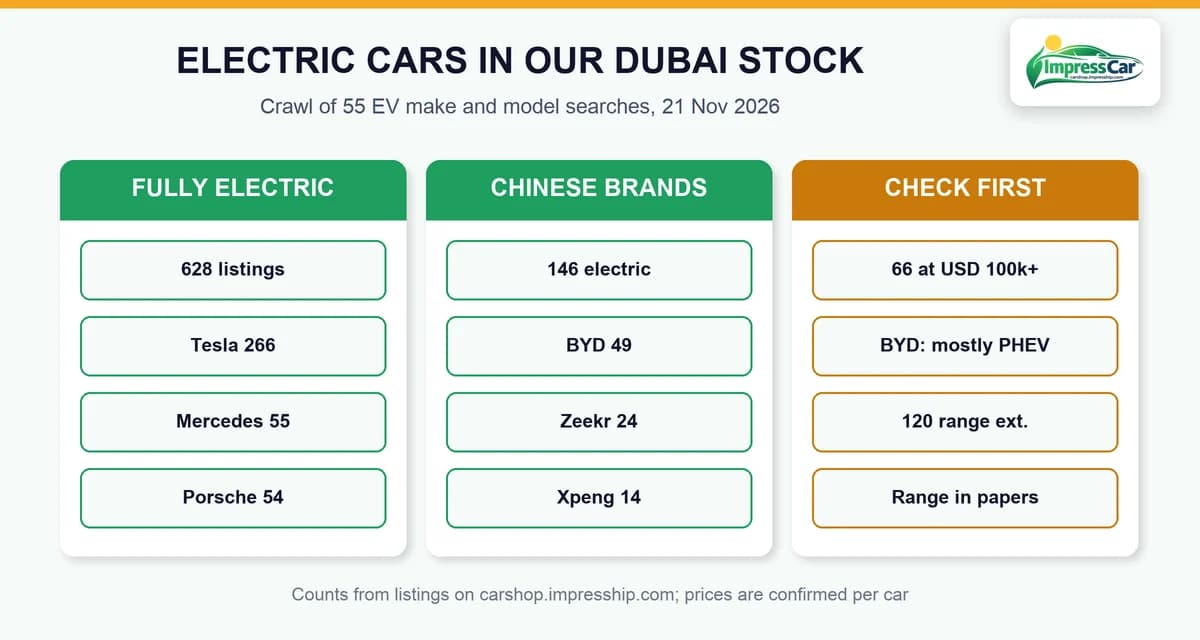
We crawled 55 electric make and model searches on our inventory on 21 November 2026 and read the fuel field of every listing:
| What we counted | Listings |
|---|---|
| Fully electric cars | 628 |
| Tesla (Model 3 and Model Y lead) | 266 |
| Mercedes-Benz (EQS, EQE, EQB, EQA) | 55 |
| Porsche Taycan | 54 |
| BYD fully electric | 49 |
| Chinese brands, fully electric | 146 |
| Model year 2023 or newer | 466 (74 percent) |
| GCC specification named | 325 |
| Asking price at or above USD 100,000 | 66 |
Three findings matter for the IDEC:
- Most BYD listings are plug in hybrids. The same searches found 187 BYD hybrids (Leopard 77, Song 26, Seal 18, Qin 17) against 49 fully electric BYDs. Only the fully electric ones are on the eligible list.
- Range extenders need a range check. We counted 120 range extender listings from brands such as Rox, Li Auto, Avatr, Voyah and Seres. They qualify only if the rated electric range is at least 200 km.
- The USD 100,000 line rules out some models. Of the 66 listings at or above it, the Porsche Taycan (22) and Tesla Cybertruck (19) lead. Customs applies the cap to the declared value, so check the value on your invoice, not the advert.
Listing prices on the site are confirmed per car before you pay. Examples of electric cars in our stock today: a 2025 Tesla Model 3, a 2025 BYD Atto 3, a 2025 Hyundai Ioniq 5 and a 2024 Zeekr 001, all GCC specification and left hand drive.
Before you pay for an EV: 6 checks#
- Fully electric or EREV with 200 km? Confirm the power type and rated range from the manufacturer's papers for that version.
- Value under USD 100,000? The invoice value is what Customs reads.
- Left hand drive? Nigeria bans right hand drive imports. GCC, US and Chinese market cars are left hand drive.
- Battery health. Ask for a battery state of health reading and see the charge level and range on a live video. Our car inspection checklist covers the other checks.
- Charging. Cars built for China use the GB/T charging standard, and US market Teslas use Tesla's own plug. Check that the car can charge where you live, at home or at a public charger.
- The paperwork order. Form M, then the IDEC, then shipping, so the car on the certificate is the car on the ship.
Fact check: what AI answers say about the IDEC#
| What an AI answer said | Our check |
|---|---|
| BEVs and EREVs with 200 km+ range are exempt from duty and VAT with an IDEC; EVs over USD 100,000 are excluded (Perplexity) | Correct, matches the Customs statement of 30 July 2026 |
| Apply on the IDEC portal with your TIN and choose the energy adviser's office (Google AI Overview) | Correct; that is the support letter step, then the IDEC application itself |
| Fees are N60,000 plus a 5 percent surcharge (Google AI Overview) | Correct per the guidelines; the portal's fee page now shows N64,500 |
| Approval can take 60 days or more (Google AI Overview) | A claim by industry stakeholders in The Guardian; the official guideline says five working days for complete applications |
| Nigeria's used car duty is 5 percent (ChatGPT) | Wrong for petrol cars: 20 percent duty plus the 5 percent NAC levy. EVs with an IDEC pay no import duty |
Where ImpressCar stands#
We sell and ship cars from Dubai, including the electric cars counted above, and we handle customs clearance at destination through our partner agents, or you can use your own agent. Shipping is priced by the car type and size, and marine insurance is optional at our insurance rates. We share the VIN and a live video of any car before payment, which covers the range, charge and steering checks. The IDEC is your application as the importer; our Nigeria page lists the route, and our guide to exporting electric and hybrid cars to Africa compares other countries.
Frequently asked questions#
What is IDEC in Nigeria?#
IDEC is the Import Duty Exemption Certificate, a fiscal incentive issued by the Federal Ministry of Finance that exempts approved items from import duty and other customs charges. Since 2020 it is applied for only online at idec.gov.ng, and since July 2026 it is the certificate that unlocks the duty and VAT waiver on qualifying electric cars.
What is IDEC in customs?#
For Customs, the IDEC is the authority to clear listed items without collecting the waived duty. Once approved, the certificate is transmitted to the Customs system, and the clearing agent declares the car against it. Only items named on the certificate can be cleared under it, so the VIN and version must match.
How do I apply for an IDEC certificate in Nigeria?#
Register on idec.gov.ng with your TIN, get the support letter from the Office of the Special Adviser to the President on Energy through the Support Documents tab, then apply with the item template, invoice, Form M, bill of lading, tax clearance and CAC documents. Pay the administrative fee, then the 5 percent surcharge after approval.
Browse thousands of cars or send the EV you want#
Pick a fully electric car from our inventory and send us the link with your destination for one quote covering the car, export papers and shipping. Or send us the car you want with the model, year and budget, or use the WhatsApp button below.
- Nigeria
- Import Duty
- Guide
Ready to ship your vehicle?
Tell us your destination port and we'll come back with an all-in export quote.
Related reading
Nigeria
How Are Hybrid Cars Taxed by Nigerian Customs? (2026)
How are hybrid cars taxed by Nigerian Customs? The six charges on a hybrid, why hybrids missed the July 2026 EV waiver, worked figures per USD 10,000 of CIF value, Green Tax bands by model and our hybrid stock data.
Nigeria
Total Landed Cost of a Used Toyota Highlander From Dubai to Lagos (2026)
What is the total landed cost of a used Toyota Highlander from Dubai to Lagos? The 7 cost lines, the 2026 Nigerian charges, worked taxes at three CIF values, why hybrid and V6 pay the same, and what 118 Highlanders in our Dubai stock show.
Import Duty
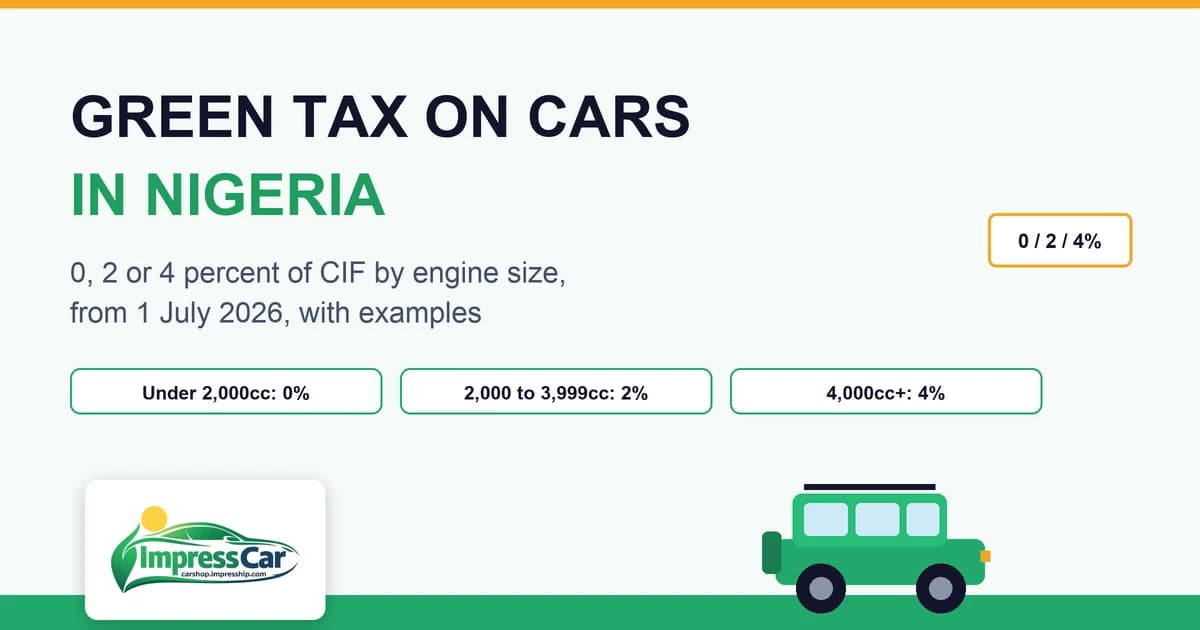
Green Tax on Cars in Nigeria: 2026 Rates by Engine Size, With Examples
What is the Green Tax on cars in Nigeria and how much is it? The 0, 2 and 4 percent bands by engine size from 1 July 2026, exemptions, worked figures per USD 10,000 CIF and 11,684 Dubai stock cars sorted by band.