Shipping
Total Loss Only vs All Risk: Which Marine Insurance Fits Your Car?
A decision guide to Total Loss Only vs All Risk Marine insurance for a car shipped from Dubai: what each plan pays for, what the extra 0.75% buys, five questions that decide your plan and which plan suits which car.
If your car is lost at sea, the shipping line's liability under the Hague Visby Rules is capped at 2 units of account per kilo, roughly USD 4,000 for a 1,500 kg saloon, whatever the car cost you. Cargo insurance fills that gap, and choosing Total Loss Only vs All Risk decides how much of it you fill. At our starting rates the two plans are only 0.75 percentage points apart (1.0% against 1.75% of the insured value), yet they pay out on very different events. This guide is a decision tool: what each plan pays for, what the extra buys and which plan suits which car, route and budget.
For most buyers, the decision comes down to one question: could you afford to repair a dent, a broken mirror or a missing part yourself? Total Loss Only pays only if the whole car is lost, for example in a sinking or a fire. All Risk Marine also pays for partial damage, theft and loading damage, which are the claims that actually happen.
Total Loss Only vs All Risk: what each plan pays for#
Both plans are set out on our marine insurance page for car shipping. Side by side, the difference is simple: Total Loss Only covers the worst case, All Risk Marine covers the worst case and the common case, and includes help from our team with any claim.
| Event during the sea voyage | Total Loss Only | All Risk Marine |
|---|---|---|
| Total loss: the vessel sinks, strands or catches fire | Covered | Covered |
| Partial damage in transit (dents, scratches, broken glass) | Not covered | Covered |
| Theft and pilferage in transit | Not covered | Covered |
| Damage while loading or unloading | Not covered | Covered |
| Wear and tear, existing faults, delay | Not covered | Not covered |
| Starting rate (of the insured value) | From 1.0% | From 1.75% |
Two things follow from the table. First, Total Loss Only is not "cheap All Risk": on a typical voyage where the car arrives with a scraped bumper, it pays nothing. Second, neither plan turns marine insurance into a warranty, because old faults and wear are excluded under both.
Ready to ship your vehicle?
Tell us your destination port and we'll come back with an all-in export quote.
What the extra 0.75% buys, in numbers#
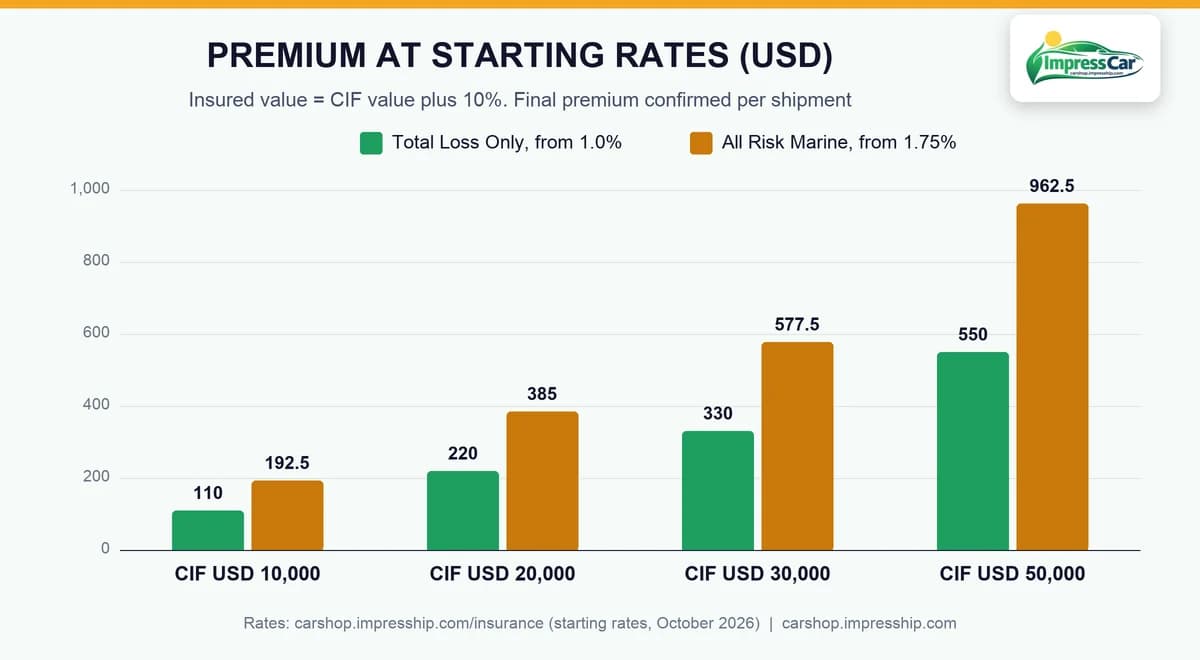
The premium is a percentage of the insured value, which is usually the CIF value (the car, freight and insurance) plus 10 percent. The table shows the gap between the plans at our published starting rates for four insured values. Your own premium is confirmed per shipment.
| CIF value | Insured value (CIF plus 10%) | Total Loss Only, from 1.0% | All Risk Marine, from 1.75% | Extra for All Risk |
|---|---|---|---|---|
| USD 10,000 | USD 11,000 | USD 110 | USD 192.50 | USD 82.50 |
| USD 20,000 | USD 22,000 | USD 220 | USD 385 | USD 165 |
| USD 30,000 | USD 33,000 | USD 330 | USD 577.50 | USD 247.50 |
| USD 50,000 | USD 55,000 | USD 550 | USD 962.50 | USD 412.50 |
The useful way to read this is to compare the "extra" column with the cost of the damage you are most likely to face. On a USD 20,000 car the upgrade costs from USD 165. If one damaged panel, one replaced mirror or one stolen part would cost you more than that to fix at home, All Risk Marine has paid for itself on a single claim. For the full premium maths, including how insurance adds to the value your customs charges duty on, see our car shipping insurance cost guide.
Five questions that decide your plan#
Work through these in order. If you answer "yes" to any of the first three, All Risk Marine is usually the better choice.
1. Is the car new, nearly new or high value?#
The higher the value, the more a partial loss hurts. A scratch on a brand new car costs the same to repaint as on an old one, but it takes far more off the resale price. A car like this 2026 Toyota Land Cruiser with 0 km is the textbook case for All Risk Marine.
2. Is it going RoRo?#
On a RoRo vessel the car is driven on and off by stevedores and parked close to other vehicles, so the usual claims are small: scuffs, dents and items taken from the cabin. Those are exactly the claims Total Loss Only does not pay. In a container the car is sealed and handling claims are fewer, which is why buyers who choose a container sometimes accept narrower cover. Our RoRo vs container comparison explains the trade off.
3. Does the route involve more handling?#
Some sailings to West and Central Africa call at other ports or transship on the way, and every extra port means another round of loading and unloading. More handling raises the chance of a partial loss, not a total one.
4. Could you pay for a repair without it hurting?#
If the car is an older, lower value runner and a repair bill would be a nuisance rather than a loss, Total Loss Only can be a rational choice. You are buying protection against the event that would wipe out the whole purchase, and accepting small damage as your own risk.
5. Does the car travel on by road after the port?#
Both plans are for the sea voyage. If the car then goes by road to another city or a landlocked country, ask about Extended Inland cover, which builds on All Risk Marine and is quoted per route.
Which plan suits which car#
The table pulls the five questions together. It is a starting point for the conversation, not a rule; we confirm the plan level and premium in your quote.
| Your situation | Plan that usually fits | Why |
|---|---|---|
| New or nearly new car, any method | All Risk Marine | Small damage takes a large share off the value |
| High value car in a container | All Risk Marine | Sealed box, but a total loss or a dropped container still hurts most |
| Mid value car going RoRo | All Risk Marine | Handling damage and theft are the likely claims |
| Older, lower value runner going RoRo | Total Loss Only can work | You accept small damage, you insure against losing the car |
| Two or more cars sharing a container | All Risk Marine | One loading incident can affect every car in the box |
| Car going inland after the port | All Risk Marine plus Extended Inland | Road legs carry their own risk, quoted per route |
| Car bought CIF from another seller | Check the certificate | A CIF seller only has to buy minimum cover by default |
That last row deserves a note. Under the ICC's Incoterms 2020 rules, a seller selling CIF only has to buy the minimum cover (Institute Cargo Clauses C), which covers named major events and not handling damage. If someone else's CIF price includes "insurance", ask which clause the certificate shows before you compare it with our plans.
What Total Loss Only will not pay for#
Buyers sometimes pick Total Loss Only expecting it to work like a cheaper version of full cover. These are the situations where it pays nothing:
- A dented door or bumper found when the car is discharged.
- A broken mirror, lamp or windscreen from loading or lashing.
- Missing parts such as a spare wheel, jack or infotainment unit.
- Theft from the cabin during the voyage or at the port.
- One car damaged when a container is mishandled, if the car is not a total loss.
All of these are partial losses, which is the line the Institute Cargo Clauses that most cargo policies follow also draw between their widest and narrowest forms. Our guide to marine insurance for car shipping explains clauses A, B and C in detail.
Before you decide: four checks#
- The insured value. Insure for the CIF value plus 10 percent, not just the price you paid, so a total loss claim covers the freight and insurance you also lost.
- Where cover starts and ends. The insurance certificate states it. Ask us to confirm it for your shipment before the car sails.
- Photos at both ends. We send the VIN and a live video of the car before you pay; keep them. At your port, inspect and photograph the car before you sign for it, because damage not noted on delivery is hard to prove later.
- Your quote. The plan level and premium appear in your quote next to the car, UAE export papers and sea freight. Our guide to what a car shipping quote covers shows where insurance sits.
Cover has to be chosen before the car sails: insurance cannot be bought after damage is found. If you are unsure, tell us the car, its value and your port, and we suggest a plan with the reasons.
Frequently asked questions#
What does all risk insurance cover?#
All risk cargo insurance covers physical loss of or damage to the car from any external cause during the insured journey, unless the cause is specifically excluded. For a car shipped from Dubai, our All Risk Marine plan covers partial and total damage, theft and pilferage in transit and damage while loading or unloading, as listed on our insurance page. Wear and tear, existing faults and delay are still excluded.
What is the difference between ICC A and B and C?#
Institute Cargo Clauses A, B and C are the standard cargo insurance forms. Clause A is the all risks form, covering every cause of loss that is not excluded, while Clauses B and C are named perils forms that cover only the events they list, such as fire, sinking or collision. A Total Loss Only plan is narrower still, because it pays only when the whole car is lost.
What defines a total loss?#
A total loss is when the car is destroyed, lost with the vessel, or so badly damaged that it cannot be recovered or repaired at a sensible cost. In marine insurance this covers events such as a sinking, stranding or a fire on board. Under a Total Loss Only plan, anything short of that is not a claim, which is why the small premium gap between the two plans matters when you choose.
Does shipping insurance cover theft?#
It depends on the plan. All Risk Marine covers theft and pilferage in transit, while Total Loss Only does not, unless the whole car disappears. Personal items left inside the car are usually excluded under both, so ship it with an empty cabin, as our RoRo vs container guide also advises.
What is not covered by marine insurance?#
Both plans exclude wear and tear, existing faults, delay, mechanical breakdown and personal items left in the car. Standard cargo clauses also exclude war, strikes and riots, which are covered only when separate war and strikes clauses are added; the Allianz Safety and Shipping Review 2026, as summarised by the IIMS, notes that cover stayed available through the recent Gulf conflict but premiums rose.
Browse thousands of cars or send the car you want#
Choose a left hand drive car from our inventory and tell us your destination port, and we quote the car, export papers, shipping and, if you want cover, the insurance plan that fits it; marine insurance is optional. Or send us the car you want with your budget, or use the WhatsApp button below. Shipping questions are covered on our car shipping page.
- Shipping
- Guide
- Africa
Ready to ship your vehicle?
Tell us your destination port and we'll come back with an all-in export quote.
Related reading
Shipping
How to Prepare a Car for Shipping: RoRo Checklist from Dubai
How to prepare a car for shipping by RoRo from Dubai to West and Central Africa: the eight step checklist (fuel, battery, leaks, tyres, empty cabin, fittings, keys, photos), the documents, cars that need extra planning and what to check at your port.
Shipping
Shared Container Car Shipping Explained: How It Works and Who It Suits
Shared container car shipping from Dubai explained: how two to four cars share a sealed 40ft container, how many cars fit by container type, who it suits, the delay and damage risks and what to ask before booking a slot.
Shipping
Car Shipping Quote from Dubai: The Details We Need and What It Covers
what the quote covers (car, UAE export papers, sea freight, optional insurance)