Shipping
Marine Insurance for Car Shipping: ICC A, B and C Explained for Dubai to Africa
How marine insurance for car shipping works from Dubai to West Africa: ICC A, B and C clauses, RoRo vs container cover, what is typically excluded and what a premium costs.
More than 200 fires were reported on large ships in 2025, the second highest total in a decade, according to the Allianz Safety and Shipping Review 2026 as summarised by the IIMS. Total losses are rarer than they were, but when one happens, a car without cover is simply gone. Marine insurance for car shipping is the small line on a Dubai export quote that decides whether a bad voyage costs you a claim form or the whole car. This guide explains the clauses, how RoRo and container cover differ, what is typically excluded and what it costs.
For most buyers, the decision comes down to three choices: how wide the cover is (ICC A, B or C), what value it is based on (usually the CIF value plus 10 percent), and where it starts and ends. Choose all three before the car sails, because cover cannot be bought once something has gone wrong.
Why the carrier's liability is not enough#
Shipping lines do carry liability, but it is narrow. Under the Hague Visby Rules, which many bills of lading follow, the carrier's liability is capped at 666.67 units of account per package or 2 per kilo of gross weight, whichever is higher. For a saloon of about 1,500 kg that is 3,000 units of the IMF's Special Drawing Right, roughly USD 4,000 at recent rates.
The same rules also excuse the carrier for fire, unless it was the carrier's own fault, and for errors in navigating the ship. You would also have to prove the carrier was at fault and sue within one year. Cargo insurance pays on the event itself, which is why our RoRo vs container guide treats it as strongly recommended.
Ready to ship your vehicle?
Tell us your destination port and we'll come back with an all-in export quote.
ICC A, B and C: what each clause covers#
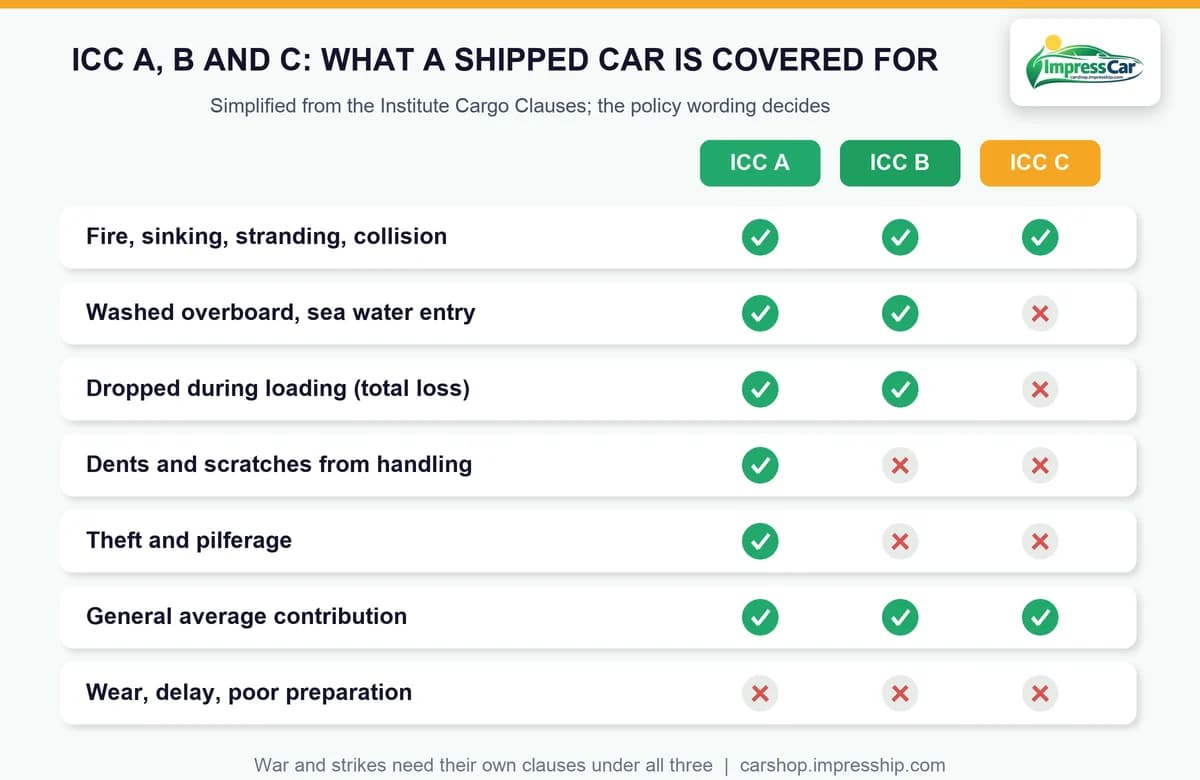
Most cargo policies are written on the Institute Cargo Clauses, published by the London market. Clause A covers "all risks of loss of or damage" except listed exclusions, as the ICC (A) 2009 wording states. Clauses B and C cover named events only.
| Event | ICC A | ICC B | ICC C |
|---|---|---|---|
| Fire, sinking, stranding, collision | Covered | Covered | Covered |
| General average and salvage | Covered | Covered | Covered |
| Washed overboard, sea water entering the hold or container | Covered | Covered | Not covered |
| Total loss of a unit dropped while loading or discharging | Covered | Covered | Not covered |
| Dents, scratches and handling damage | Covered | Not covered | Not covered |
| Theft and pilferage | Covered | Not covered | Not covered |
| Wear and tear, delay, poor preparation | Not covered | Not covered | Not covered |
For a car, the gap matters. The damage that actually happens on most voyages is a dented panel, a broken mirror or a missing part, and only Clause A responds to those. Even then, Lloyd's own cargo claims manual warns that "all risks" does not mean every loss, however it occurs, is covered.
One more trap sits in the sale terms. Under the ICC's Incoterms 2020 rules, a seller selling CIF only has to buy Clause C cover by default, while CIP requires Clause A. If you buy CIF, ask which clause the certificate shows.
RoRo vs container: how the risks differ#
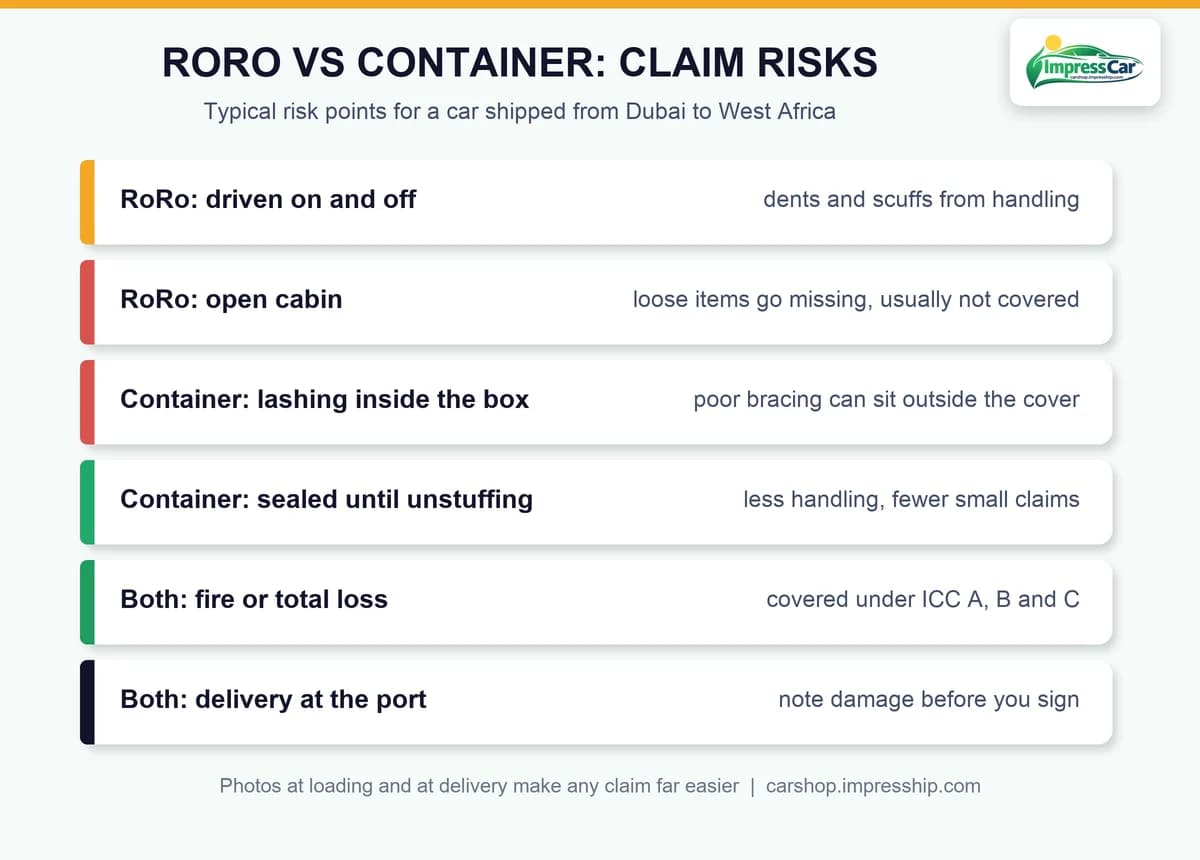
On a RoRo vessel the car is driven on and off by stevedores, so the usual claims are small: scuffs, dents and items taken from the cabin. Personal effects left in the car are typically excluded, and carriers usually ask for an empty cabin anyway.
In a container the car is sealed from Dubai to unstuffing, so handling claims are fewer. The risk moves inside the box. The ICC exclusions remove damage caused by poor packing or preparation, and "packing" includes stowage in a container when it is done by the insured or before the cover starts. Lashing and bracing quality therefore matters for the claim as well as for the car. High value cars such as this 2021 Nissan Patrol SE Platinum often go by container for exactly this reason.
What marine insurance for car shipping typically excludes#
- Wear, tear and existing faults. Rust, old damage or a gearbox that was already failing are not transit losses.
- Mechanical or electrical breakdown that was not caused by an insured event, which policies for vehicles typically exclude.
- Delay. A late vessel or a congested port is not a claim, even if the delay was caused by an insured event.
- War and strikes. These need the separate Institute War and Strikes Clauses. The Allianz review notes that cover stayed available through the recent Gulf conflict, but hull and cargo premiums rose.
- Undeclared damage. Damage you did not note on delivery is hard to prove later, so inspect and photograph before you sign.
What it costs and how to buy it#
Premiums are a percentage of the insured value, usually the CIF value. Insurance is optional with ImpressCar, and you choose the cover. Our marine insurance options start from 1.0 percent of value for Total Loss Only, which covers total loss at sea, and from 1.75 percent for All Risk Marine, which adds partial damage, theft and pilferage in transit and loading or unloading damage. Extended Inland cover for the road leg after the port is quoted per shipment.
| Example car from our stock | Export price | Insured value (CIF plus 10%, approx.) | Total Loss Only, from 1.0% | All Risk Marine, from 1.75% |
|---|---|---|---|---|
| 2024 Toyota Camry GLE, RoRo | USD 27,945 | USD 32,000 | USD 320 | USD 560 |
| 2021 Nissan Patrol SE Platinum, container | USD 39,545 | USD 46,000 | USD 460 | USD 805 |
These are indicative rates, not quotes: the final premium is confirmed per shipment on the vehicle, route and cover level. Insurance also feeds your duty bill, because customs in Ghana and Nigeria assess duty on the CIF value, as our Ghana import duty guide shows. Set the cover with the rest of the export cost breakdown before the car sails.
Ask for the policy to start when the car leaves the Dubai yard, not at the ship's rail, and to run until delivery at your port (or your door, with inland cover). The insurance certificate then joins the car export documents in your file, and our shipping team can quote the cover together with the freight.
Frequently asked questions#
Is marine insurance mandatory when shipping a car?#
No, it is not legally required for a car leaving Dubai, but it is strongly recommended. Carrier liability is capped and excludes events such as fire, so without cargo cover a total loss usually falls on the owner. Our insurance page sets out the cover levels.
What does marine insurance cover when shipping a car?#
It depends on the clause. ICC A covers loss or damage from any cause except listed exclusions, including handling damage and theft, while ICC B and C only cover named events such as fire, sinking and collision. The ICC (A) wording lists the exclusions in full.
What is the difference between ICC A, B and C?#
ICC A is all risks, subject to exclusions. ICC B covers a list of major events plus sea water damage and units lost overboard or dropped during loading, and ICC C covers only the most serious events such as fire, sinking, stranding and collision. For a car, only ICC A reliably covers dents, scratches and theft.
How much does marine insurance cost to ship a car?#
It is priced as a percentage of the insured value, usually the CIF value plus 10 percent. Our indicative rates start from 1.0 percent for Total Loss Only and 1.75 percent for All Risk Marine, which works out to roughly USD 320 to 560 on a USD 28,000 saloon shipped RoRo.
Does RoRo shipping include insurance?#
No. RoRo freight includes the carrier's limited legal liability, not cargo insurance, and that liability is capped by weight or unit under the Hague Visby Rules. Our RoRo vs container guide explains why separate cover is worth it for both methods.
What is not covered by marine insurance?#
Typical exclusions are wear and tear, existing faults and mechanical breakdown, delay, poor packing or container stowage arranged by the insured, and war or strikes unless those clauses are added. Personal items left in the car are usually excluded too.
Browse 700+ cars or send the car you want#
Pick a car from the current inventory and ask for the shipping quote with insurance included, so you see one landed figure. Or send us the car you want with your budget and destination port and we will come back with options and cover levels, or use the WhatsApp button below.
- Shipping
- Insurance
- Guide
Ready to ship your vehicle?
Tell us your destination port and we'll come back with an all-in export quote.
Related reading
Exporting
Car Export Documents in the UAE: The Complete Checklist for Africa (2026)
Every car export document in the UAE, in the order you get it: RTA export certificate and deregistration, Mulkiya, customs exit, bill of lading and what your destination port asks for.

Buying
GCC Spec vs US Spec Cars: Which to Buy in Dubai for Export to Africa
GCC spec vs US spec cars explained for African buyers: what really differs, how to tell them apart, like for like prices from live Dubai stock and when a US spec car is worth it.

Buying
VIN Check in Dubai: How to Verify a Car Before You Buy (2026)
A practical VIN check in Dubai, step by step: where to find the 17 characters, how to decode them, which history records to pull and the red flags that should stop a deal.