Import Duty
Benin Car Import Duty: Cotonou Taxes and the Transit Trade
Benin car import duty explained from the customs guide: 20 percent duty, levies and 18 percent VAT on a car cleared in Cotonou, a worked example, how transit cars move to Niger and Burkina Faso, and why cars for Nigeria should ship to Lagos.
Cotonou has been one of West Africa's busiest used car ports for decades. A 2014 tralac report put Benin's imports at 314,000 vehicles a year, with most of them heading on to Nigeria. This guide to Benin car import duty explains what a car cleared in Cotonou actually pays, according to Benin's own customs guide, how the transit trade to Niger and Burkina Faso works today and why a car for Nigeria should not be landed in Cotonou.
In short: a car cleared for use in Benin pays 20 percent customs duty, about 3 percent in statistical and community levies and 18 percent VAT on the total, which comes to roughly 45 percent of the customs value before any large engine tax. A car in transit to a landlocked country pays transit charges instead, and moves under electronic tracking and customs escort to the border.
Benin car import duty: the taxes on a car cleared in Cotonou#
The Benin customs administration (DGDDI) publishes a practical guide to the duties and taxes collected at the border. Its worked example for a passenger car (HS heading 8703) imported from outside West Africa lists these charges:
| Tax | Rate in the customs guide | Charged on |
|---|---|---|
| Customs duty (DD) | 20 percent | Customs value |
| Statistical fee (RS) | 1 percent | Customs value |
| UEMOA solidarity levy (PCS) | 0.8 percent | Customs value |
| ECOWAS levy (PC) | 0.5 percent | Customs value |
| African Union levy (PS) | 0.2 percent | Customs value |
| Urban development fee (RAU) | 0.5 percent | Customs value |
| VAT (TVA) | 18 percent | Customs value plus the duty and levies above |
| Large engine tax (TGC) | 10 percent in the guide's example | Same base as VAT, only on cars it applies to |
Small fixed fees per declaration are added on top. The guide dates from 2018, so treat the rates as the structure and confirm the current figures for your exact car with the customs duty and tax simulator on the GUCE platform or with your clearing agent.
Ready to ship your vehicle?
Tell us your destination port and we'll come back with an all-in export quote.
A worked example per 1,000,000 CFA of customs value#
The customs value is the starting point, and it is not simply the price you paid. For imports at the port, Benin Control checks the commercial documents and issues an Attestation de Vérification Documentaire (AVD) that sets the value used for the declaration, as the customs page on clearance at the Port of Cotonou explains. For used cars, Cotonou clearing agents work from reference values by make, model and year.
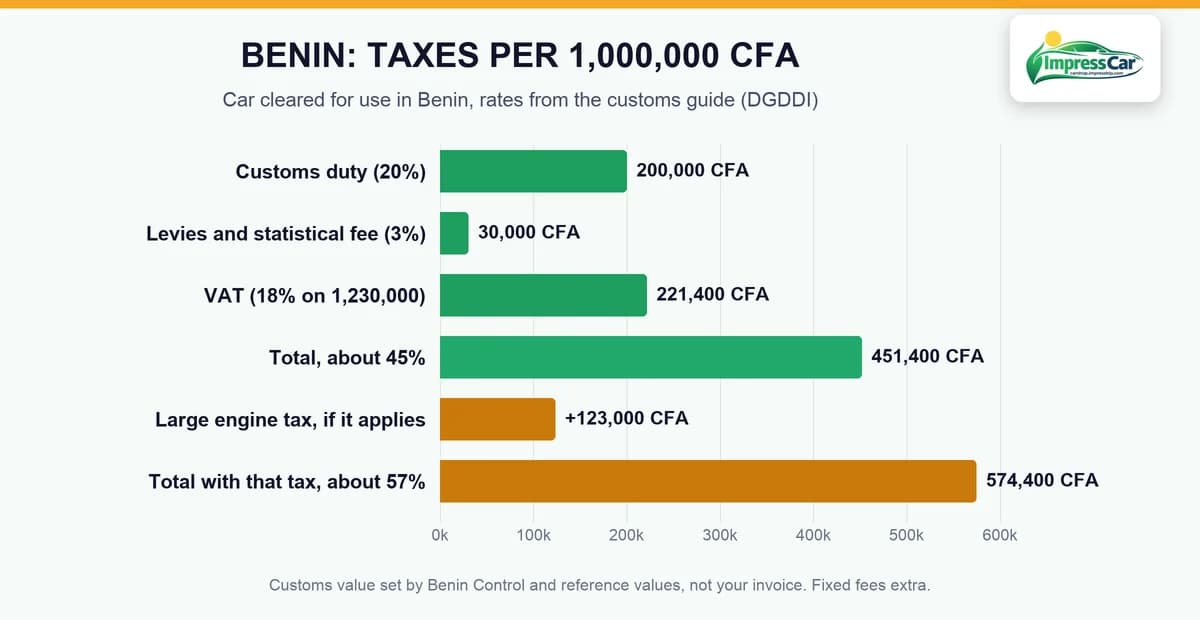
Per 1,000,000 CFA of customs value, at the guide's rates:
- Customs duty at 20 percent: 200,000 CFA.
- Statistical fee and the four levies together (3 percent): 30,000 CFA.
- VAT at 18 percent on 1,230,000 CFA: 221,400 CFA.
- Total: 451,400 CFA, or about 45 percent of the customs value.
- If the large engine tax applies, add 10 percent of 1,230,000 CFA (123,000 CFA), for a total of about 57 percent.
Nigerian forums have long repeated that Benin charges a flat CFA 500,000 on any car. That is not how the customs guide works: the duty is a percentage of the customs value, so a larger, newer car pays more. Compare the same maths for Ghana in our Ghana car import duty guide and for Senegal in our Senegal car import duty guide.
The Cotonou transit trade: Niger, Burkina Faso and beyond#
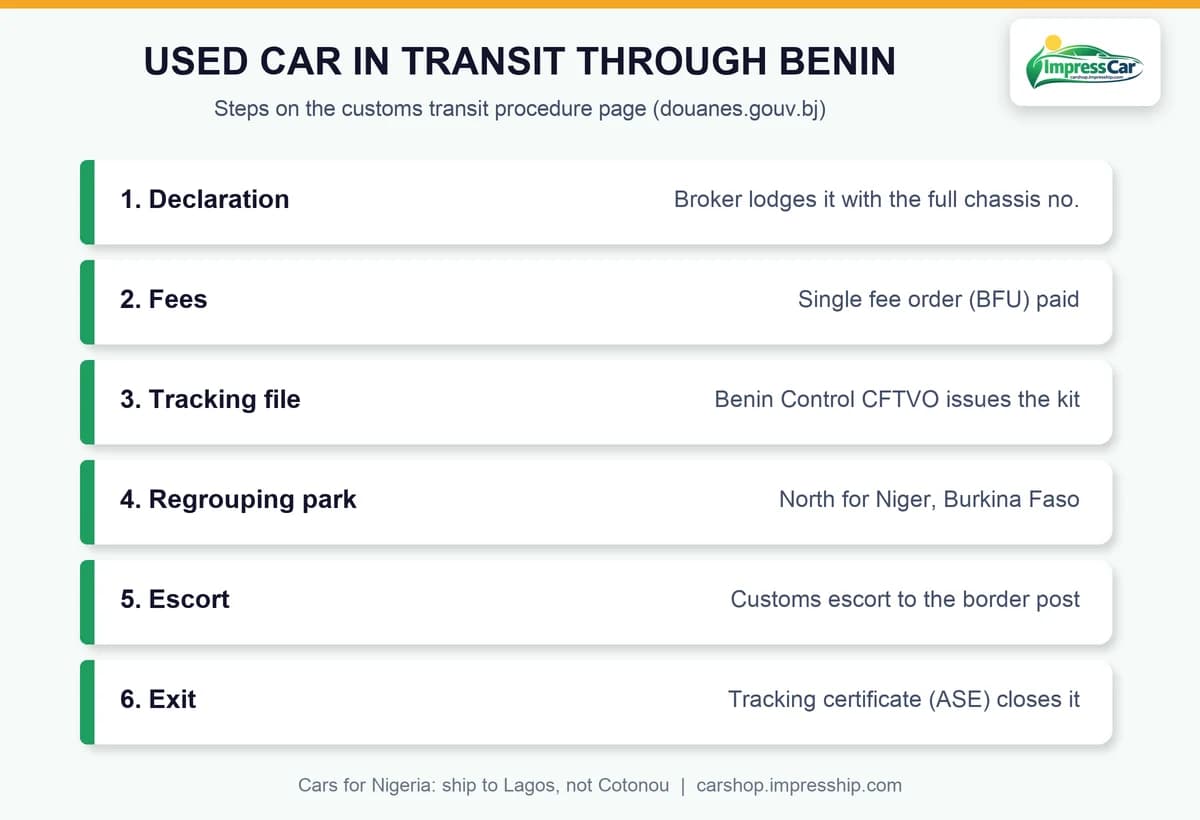
A car that is only passing through Benin is not cleared for use there. It travels under the transit regime, which suspends Benin's duty and VAT and charges transit fees instead. The customs page on transit procedures in Benin sets out the steps for used vehicles:
- The licensed customs broker lodges the declaration with the full chassis number and the details of the person collecting the car.
- The single fee order (BFU) is paid.
- Benin Control's transit centre for used vehicles (CFTVO) opens an electronic tracking file and issues the tracking kit at the sale park.
- Cars for Niger, Burkina Faso and other inland countries go to the northern regrouping park; cars for other destinations go to the southern one.
- From there, the cars leave for the border under customs escort, and are checked again at the exit post.
- Once the car has left Benin, an electronic tracking certificate (ASE) closes the file with the broker.
This is the trade that built Cotonou's huge car parks. Its route depends on conditions at each border, so ask us before you plan a car for Niger or Burkina Faso through Cotonou; our guide to importing a car to Mali and Burkina Faso covers the destination side.
Why a car for Nigeria should not land in Cotonou#
For years, Nigerian buyers landed cars in Cotonou and drove them across the border, because Benin's charges were lower than Lagos. Since 1 January 2017, Nigeria has accepted vehicle imports only through its seaports, as the ICIR reported when the ban was announced, and in 2026 the restriction was still in place according to Leadership. Our guide to shipping a car to Togo and Benin covers the rule in detail.
Benin has also tightened its own land borders: under customs circular 117 of 20 August 2026, vehicles are no longer cleared at land border posts; a vehicle arriving from a neighbouring country is moved under tracking to the customs office for vehicles. If the car's final home is Nigeria, ship it to Lagos, where a used car pays 20 percent import duty plus the 5 percent NAC levy on the CIF value. Our Nigeria import guide explains the rest.
Age rules, documents and the Dubai side#
Age. Reports on a Benin age limit for used cars conflict, from no limit at all to 7 or 10 years, and the customs pages we checked set no limit. Check the current rule before you choose an older car.
Documents before sailing. Every shipment to Benin needs the BESC, Benin's electronic cargo tracking note, as the Maersk Benin import page notes. On the Dubai side, the car needs the RTA export certificate, and the certificate of origin comes with the car export documents, with no embassy legalisation on our main routes. Our car export documents checklist lists the rest.
Steering. Benin drives on the right, so the left hand drive cars in our inventory suit it. We share the VIN and a live video of any car before payment.
Clearance and insurance. We handle customs clearance at Cotonou through our partner agents, or your own clearing agent can clear the car with the documents we send. Freight is quoted per car; the method and loading port are confirmed when you book, and our shipping page explains each step. Marine insurance is optional, at our insurance rates from 1.0 percent for Total Loss Only and 1.75 percent for All Risk Marine, and we recommend it for newer cars. Our destinations page lists every port we ship to.
Frequently asked questions#
How to calculate vehicle import duty?#
Start from the customs value, then apply each tax in order. In Benin, that means 20 percent duty, about 3 percent in statistical and community levies, and 18 percent VAT on the value plus the duty and levies, which gives about 45 percent before any large engine tax. Our Ghana car import duty guide shows how the same steps work in Ghana.
How can I check the duty payable for my car?#
Use the GUCE duty and tax simulator run by Benin's foreign trade single window, or ask a licensed clearing agent in Cotonou for a simulation with the make, model, year, engine and chassis number. Send us the car you want and we will include the clearance in your quote.
Can I import a vehicle from Dubai?#
Yes. Dubai's GCC spec cars are left hand drive, which suits Benin's roads. The car leaves Dubai with an RTA export certificate and the export documents, the BESC is issued before sailing, and the car is cleared at Cotonou. Our guide to shipping a car from Dubai to Togo and Benin walks through each step.
Browse thousands of cars or send the car you want#
Choose a left hand drive car from our inventory and send us the link with Cotonou or your final inland destination for one quote covering the car, export papers and shipping. Or send us the car you want with your budget and destination, or use the WhatsApp button below.
- Import Duty
- Africa
- Shipping
Ready to ship your vehicle?
Tell us your destination port and we'll come back with an all-in export quote.
Related reading
Import Duty
Import a Car from Dubai to Ethiopia via Djibouti: Electric Car Rules, Duty and Steps
How to import a car from Dubai to Ethiopia in 2026: the restriction on petrol and diesel cars, which electric cars qualify, the duty and VAT exemption on EVs, left hand drive, and the route via Djibouti to Modjo.
Shipping
Shipping a Car from Dubai to Angola: Luanda, the 5 Year Rule, Duty and Documents
Shipping a car from Dubai to Angola: Luanda or Lobito, the 5 year age limit for used cars under Decree 155/20, import authorisation, the CNCA loading certificate, duty and 14% VAT, and RoRo or container shipping.
Shipping
Shipping a Car from Dubai to Cameroon: Douala, BESC, Duty and Age Tax
Shipping a car from Dubai to Cameroon: Douala or Kribi, the 2026 excise duty by vehicle age, CEMAC duty and VAT, the BESC and CAMCIS vehicle details, documents, and RoRo or container shipping.